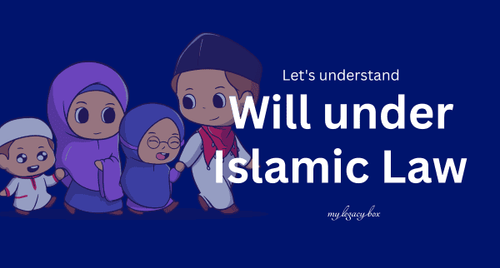
In Muslim law, a will (wasiyat) is a very important concept, but it works differently from other personal laws. The law tries to strike a balance between two things: the freedom of a person to distribute their property and the protection of the legal heirs. So, while a Muslim can make a will, there are certain clear limits and rules that must be followed. The focus is more on the intention of the person making the will rather than strict technical formalities. Let’s understand each aspect in a simple and structured manner.
Capacity to make a Will
Every Muslim who is of sound mind and has attained the age of majority can make a valid will. This means the person should understand what they are doing and should not be mentally incapable at the time of making the will.
A minor cannot make a valid will. However, if a minor makes a will, it may be ratified after attaining majority. Similarly, a person of unsound mind cannot make a will, but if such a person makes a will during a lucid interval (a period when they are mentally stable), the will can be valid.
Also, if a person becomes insane after making a will, it does not affect the validity of the will made earlier. But if a will is made under coercion, undue influence, or fraud, it becomes invalid because it does not reflect the true intention of the testator.
Courts are very cautious in such cases and carefully examine the circumstances before accepting the will. Interestingly, even if a person later commits suicide, the will made by them is not considered invalid on that ground.
Formalities of a Will
One of the most flexible aspects of Muslim law is that it does not require strict formalities for making a will. A will can be made orally, in writing, or even through gestures, as long as the intention is clearly expressed.
There is no requirement of signature, attestation, or registration. However, the declaration must be clear and unambiguous. It should show that the person intended to distribute their property after death.
The will must clearly mention:
- Who is receiving the property (legatee),
- What property is being given,
- And to what extent.
If there is ambiguity or uncertainty in any of these, the will may fail. A will can also be conditional, but the condition should not be illegal or against the nature of the bequest. If a condition is invalid, it may be ignored, but the will can still remain valid if it stands independently.
Subject matter of Will
The subject matter of a will refers to the property being disposed of. Under Muslim law, a will can cover both movable and immovable property, and even corporeal or incorporeal property.
The property does not necessarily have to exist at the time the will is made, but it must exist at the time of the testator’s death. This is important because a will only takes effect after death.
A unique feature is that a person can divide rights in property. For example, one person can be given the usufruct (right to enjoy benefits), while another can be given ownership (corpus). However, the property must be clearly identifiable. If it is vague or uncertain, the bequest may not be valid.
Bequeathable One-Third

This is the most important rule in Muslim wills and often asked in exams. A Muslim can only bequeath up to one-third of their property through a will, after paying funeral expenses, debts, and other charges.
If a person tries to give more than one-third, that excess part will not be valid unless the legal heirs give their consent after the death of the testator.
This consent:
- Must be given after death (not before),
- Can be express or implied,
But silence does not count as consent.
The heirs are identified at the time of death, not at the time of making the will. If there are no heirs, then the person can dispose of the entire property through a will.
Most schools of Muslim law follow this one-third rule strictly. Under Hanafi law, the consent of heirs is absolutely necessary for validating any excess bequest.
Custom
Custom has a very limited role in Muslim law of wills. If a custom goes against the basic principles of Muslim law, it will not be accepted.
For example, any custom that restricts who can receive a bequest is considered void. However, customs that are in harmony with Muslim law principles may be recognized.
An important concept here is marz-ul-maut (death-bed gifts). These are gifts made when a person is seriously ill and expecting death. Such gifts are treated similarly to wills and are also subject to the one-third limitation. If they exceed one-third, the consent of heirs is required.
Legatee
A legatee is the person who receives the benefit under a will. Under Muslim law, a bequest can be made in favour of any person, whether they are a stranger or a legal heir.However, there is an important restriction:
A bequest in favour of an heir is not valid unless other heirs consent to it after the death of the testator.
On the other hand:
A bequest in favour of a stranger is valid up to one-third without any consent.
The legatee must be capable of receiving the property at the time of the testator’s death. Also, a person who causes the death of the testator (a murderer) is disqualified and cannot receive any benefit under the will.
Bequests can also be made for religious, pious, or charitable purposes, and such bequests are generally upheld, provided they follow the rules of Muslim law.
Bequest for Heirs
Under Muslim law, a bequest in favour of an heir is not valid unless the other heirs consent to it after the death of the testator.
This rule ensures that no heir is given an unfair advantage over others. The consent must come after death because only then the heirs are finally determined. Even if the bequest is within one-third, consent is still required if it is made in favour of an heir.
However, once consent is given, the bequest becomes valid. Such consent may be express or implied, but mere silence is not sufficient.
Legacy to a Murderer
A person who causes the death of the testator is not entitled to the legacy. This rule is based on the principle that no person should benefit from their own wrong.
Under most schools, the murderer is excluded from taking the legacy whether the act was intentional or accidental. However, under Ithna Ashari law, exclusion applies mainly when the homicide is intentional.
It is immaterial whether the bequest was made before or after the act causing death.
Construction of Wills
The construction of a will depends on the intention of the testator. Courts try to give effect to that intention as far as possible.
Where the language is ambiguous, the court interprets it in light of surrounding circumstances. A will speaks from the death of the testator, not from the date it is made.
If a person bequeaths something which he does not own at death, the bequest fails, but if the intention was to give value, then value may be given instead. The court tries to uphold the will rather than invalidate it.
Revocation of the Will
A will is revocable at any time before the death of the testator. It may be revoked either expressly or impliedly.
Express revocation happens when the testator clearly declares that the will is revoked.
Implied revocation occurs when the testator does something inconsistent with the will, such as:
selling the property,gifting it away,or destroying the subject matter.
If a later will is made, it revokes the earlier one to the extent of inconsistency. Even burning or tearing the will may amount to revocation.
A will is thus ambulatory in nature, meaning it can be changed any time during the lifetime of the testator.
In conclusion, the Islamic law of wills is defined by a careful balance between personal testamentary freedom and the protection of family interests. The one-third rule serves as the cornerstone of this system, ensuring that a Muslim can bequeath a portion of their estate while safeguarding the mandatory shares of legal heirs