Why “khandani zameen” doesn’t always mean what our families think it means and what the J. Rajesh ruling changes for heirs, parents and property buyers.
In most Indian homes, there is one sentence we have all heard at some point: “Yeh toh khandani zameen hai, isme bachchon ka bhi hissa hai.” This is family land; the children have a share in it too.
It is said with great confidence at weddings, after funerals, and during those tense conversations over Diwali chai. For decades, many of us simply assumed it was the law.
On 6 November 2026, the Supreme Court politely but firmly reminded us that, very often, it isn’t.
The ruling in 30 seconds
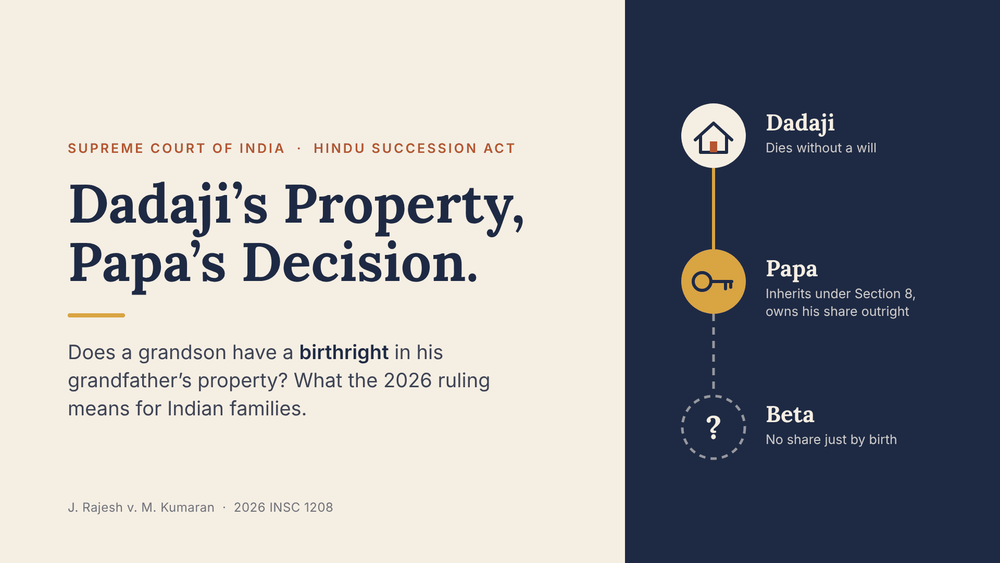
If your grandfather died without a will and his property passed to your father as one of his legal heirs (and was then divided among those heirs), that share belongs to your father alone. You do not get a share in it just by being born. Your father can sell it, and you cannot undo the sale.
J. Rajesh (Minor) v. M. Kumaran (Dead) Through LRs & Ors., 2026 INSC 1208 - Justices Augustine George Masih and Sunita Agarwal
A three-year-old’s case, decided when he was 32
The story begins in Chennai. N. Ramakrishnan passed away without leaving a will. His children went to court to divide what he left behind, and in February 1994 a compromise decree gave a small plot, about 1,811 sq ft, to his son.
Barely a month earlier, that son had become a father to a boy named Rajesh. In 1997, the father sold the plot. That same year, three-year-old Rajesh, through his mother, went to court with a simple argument: this was my grandfather’s land, I had a share in it from the day I was born, and my father had no right to sell it alone.
The trial court agreed with him. The first appellate court did not. The Madras High Court did not either. Finally, almost three decades after the suit was filed, the Supreme Court gave its answer: no.
What the Court said, in plain words
The entire case turned on one provision: Section 8 of the Hindu Succession Act, 1956. It decides who inherits when a Hindu man dies without a will. It lists “Class I heirs” — his widow, sons, daughters and mother, among others. A grandson whose father is still alive is not on that list.
From there, the Court’s reasoning follows naturally:
The father inherited as an individual. What he received under Section 8, and then got in the 1994 partition, became his own property. It was not joint family property he was holding on behalf of his children.
So the grandson had no birthright in it. Following its 1986 decision in Commissioner of Wealth Tax v. Chander Sen, the Court said the clear words of Section 8 must prevail over the older joint-family idea.
Timing sealed it. Succession to the grandfather’s estate had opened before Rajesh was born, so nothing passed to him.
A son cannot claim more than his father had. Since the father owned the plot outright, the sale to the buyers stood.
The Court also held that neither Section 6 of the Act (which deals with joint family, or coparcenary, property) nor Tamil Nadu’s own amendment helped the grandson, because this property reached the father through inheritance, not through the joint family.
The real lesson: “ancestral” is about the road, not the origin
This is the part every Indian family should understand. Property does not carry its family tree with it. What matters is the road it travelled to reach you.
Broadly, there are two roads:
Road 1 - the old joint family (coparcenary) property. Under traditional Mitakshara law, sons got an interest in such property by birth, and since the 2005 amendment, daughters do too. This is the world of Section 6.
Road 2 - inheritance under Section 8. When a Hindu man dies without a will and his property goes to his Class I heirs, each heir owns their share as an individual. Their children get nothing by birth. They inherit only later, when that parent passes away.
Rajesh’s plot came by Road 2. So even though it had once been his grandfather’s land, it was never “ancestral” in the legal sense that would give him a birthright.
Not a new rule, but a much-needed reminder
It is worth saying clearly: the Supreme Court has not invented anything new here. The 1956 Act quietly changed this position nearly 70 years ago. Chander Sen settled it in 1986, Yudhishter v. Ashok Kumar followed in 1987, and courts have repeated it many times since, including in Uttam v. Saubhag Singh (2016).
Yet family belief has not caught up with the law. Partition suits are still regularly filed on the assumption that grandfather’s property automatically belongs to the grandchildren too. This judgment, coming from the Supreme Court in such clear terms, should help close that gap.
What this means for you
If you are a grandson or granddaughter
You cannot stop your parent from selling property they inherited from their own parent under Section 8. Your right comes later, as their heir, if they pass away without a will. There is one important exception: if your parent died before your grandparent, you step into their place and become a Class I heir yourself.
If you are the parent who inherited
The property is yours to sell, gift, mortgage or leave by will. But being legally free to decide is not the same as having a family that agrees. If you want the property to stay with the next generation, say so in a will or a family settlement. Don’t leave it to assumptions.
If you are a buyer
This ruling brings welcome certainty. A sale by an heir who received the property through Section 8 inheritance and partition is far less likely to be upset years later by a child claiming a birthright. Still, do your homework: ask how the seller acquired the property, and check the partition deed or decree, the legal heir documents and the full chain of title.
For daughters
Section 8 treats sons and daughters equally as Class I heirs, so this ruling applies the same way to both. Daughters’ birthright as coparceners after 2005 continues to apply wherever genuine joint family property still exists.
What hasn’t changed
This judgment does not wipe out the idea of joint family property. Where genuine coparcenary property still exists and has never been divided, children still have rights by birth under Section 6. Every case also depends heavily on its facts: when the grandfather died, whether a partition happened, how the property was held, and which state’s law applies. In this very case, the Court noted that the grandfather’s date of death was never even placed on record. Facts and documents decide these cases, not family stories.
A thought to end with
Laws are written about property, but these disputes are always about people. A suit that started when a child was three ended when he was 32. That is decades of hope, expense and strained relationships.
If this judgment does one good thing, I hope it moves our family conversations away from “What is my birthright?” towards “What have we actually planned?” Write that will. Record that partition properly. Talk openly about who gets what, and why. It is far kinder than leaving the next generation to find out in a courtroom.
Over to you: did your family grow up believing that grandfather’s property automatically belonged to the grandchildren? Has this ruling changed how you see it? I’d love to hear your thoughts in the comments.
This article is a general commentary for awareness and is not legal advice. Property and succession questions depend on specific facts and documents, so please consult a qualified lawyer before acting on your own situation.