
When someone in the family passes away without a will, the same question comes up sooner or later, usually in a quiet voice: “What does the law say?”
For Hindu families, the answer is the Hindu Succession Act, and it gets plenty of attention. For Christian and Parsi families, the answer lies in a century-old law that is talked about far less: the Indian Succession Act, 1925.
That law tells two quite different stories about women. For Parsi women, it is now a story of full equality. For Christian women, it is a story of hard-won progress, with one gap that remains.
If you belong to a Christian or Parsi family, your inheritance rights are not decided by family custom, by what relatives remember, or by the Hindu Succession Act. They are decided by the Indian Succession Act, 1925, and its rules are specific, fixed, and widely misunderstood. This guide sets out exactly what a woman is entitled to as a daughter, a wife and a mother when a family member dies without a will. It explains where the law treats her as fully equal and where it still does not. Read it before you sign any family settlement, release deed or succession paper, because a share given up in haste is very hard to win back
First, which law applies?
The Indian Succession Act covers both communities, but in separate chapters. Sections 31 to 49 govern Christians, and Sections 50 to 56 contain special rules for Parsis. These rules apply only when a person dies intestate, which simply means without leaving a valid will.
One important exception: Goa. Goan families of every religion follow the Goa Civil Code (based on the old Portuguese Civil Code, now partly replaced by a 2012 Goa law), and the Supreme Court has held that it applies even to their property outside Goa.
How we got here
Equality did not arrive on its own. For decades, Syrian Christian women in the old Travancore region were governed by a local law that gave a daughter only a limited sum, called streedhanam, while the property went to her brothers.
Educationist Mary Roy challenged that law, and in 1986 the Supreme Court ruled in her favour. Interestingly, the Court did not decide the case on the ground of discrimination. It held that the old Travancore Act had stood repealed since 1951, when Parliament extended the Indian Succession Act to that region. The result was still historic: Christian daughters in the area became entitled to equal shares, going back to 1951.
Parsi women saw their own turning point in 1991. Until then, when a Parsi man died without a will, his son received double the share of his daughter. An amendment that year removed the difference completely.
In 30 seconds
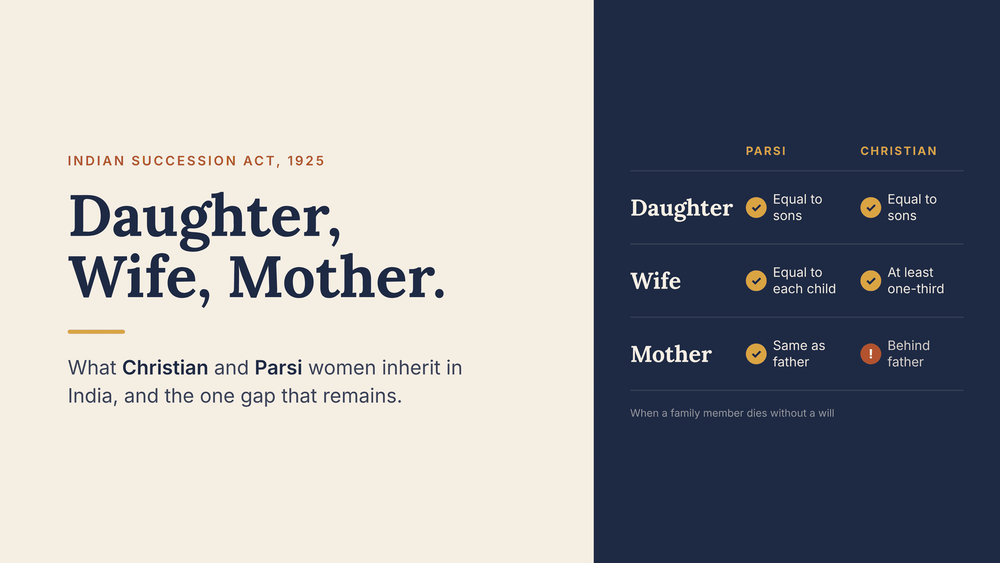
Parsi women: equal to men in every role (daughter, wife and mother) since 1991.
Christian women: equal as daughters and protected as wives, but as mothers they still stand behind fathers.
Both: whatever a woman inherits is fully hers to keep, sell, gift or leave by will.
As a daughter: equal in both communities
Under both Christian and Parsi law, sons and daughters inherit equal shares from their father and from their mother. Marriage makes no difference. A married daughter is as much an heir as an unmarried one.
If a child has already passed away, their share generally goes to their own children, so grandchildren are not left out.
As a wife: protected, but the maths differs
Christian widow
Her share depends on who else survives:
With children: one-third for her; the remaining two-thirds is split equally among the children.
No children, but other relatives: one-half for her; the other half goes to the relatives.
No relatives at all: the whole estate is hers.
The same rules apply to a husband when his wife dies.
Parsi widow
A Parsi widow is counted as one more child. She and each child receive equal shares. With no children, she takes one-half and the rest goes to other relatives. (If the widow of a predeceased son is also alive, the two of them get one-third each.) Again, a widower is treated exactly the same way.
A simple example
A man leaves ₹90 lakh, a widow and three children, and no will.
If Christian: the widow gets ₹30 lakh and each child gets ₹20 lakh.
If Parsi: the widow and each child get ₹22.5 lakh each.
As a mother: the one gap that remains
This is where the two laws part ways most sharply.
Under Parsi law, if a person dies leaving children, each surviving parent receives half the share of each child. Mother and father are treated exactly alike. In the ₹90 lakh example above, if both parents of the deceased were also alive, the estate would be split into five equal parts: ₹18 lakh each for the widow and the three children, and ₹9 lakh for each parent. (If there are no children, the spouse takes half and the parents are first in line for the other half, again on equal terms.)
Under Christian law, there is no fixed share for a mother at all. Her position depends entirely on who else is alive:
If the deceased leaves a spouse and children, the mother gets nothing. As recently as 2026, the Karnataka High Court reaffirmed this.
If there are no children but the father is alive, the father takes everything that does not go to the spouse, and the mother still gets nothing.
Only if the father has died does the mother inherit, and even then she shares equally with the deceased’s brothers and sisters. She takes everything only if there are no siblings, nephews or nieces.
Picture a young Christian man who dies unmarried, leaving both his parents. Under the law, his entire property goes to his father. His mother, who may have raised him and cared for him for 30 years, is legally a bystander. Travancore’s Christian daughters won their equality in 1986; Christian mothers are still waiting for theirs.
Whatever she inherits is truly hers
For both Christian and Parsi women, inherited property is held with full ownership. There is no “limited estate” or life-only interest. She can live in it, rent it out, sell it, mortgage it, gift it or leave it to anyone by will, without needing the consent of her husband or anyone else in the family. The same applies to property she earns or buys herself.
She can also make her own will freely. For Christians, since a 2002 amendment, a will no longer needs probate from a court before it can take effect.
What families can do today
Write a will. It is the simplest way to fill the gaps in the law. A Christian son or daughter who wants their mother to be provided for can make sure of it in a few pages.
Check which law applies to you. Christian, Parsi, Goan domicile or married under the Special Marriage Act: the rules are not the same.
Don’t sign away your share under pressure. Release deeds and “family settlements” are often signed by daughters and widows in grief. Read before you sign.
Keep documents in order. Death certificates, legal heir proof and title papers make every step easier.
It took one determined woman, Mary Roy, to secure equality for Christian daughters, and a full legislative amendment to secure it for Parsi daughters. Both changes were once called impossible. The rule that places a Christian father ahead of a Christian mother is perhaps the last piece of that unfinished work.
Until the law catches up, families don’t have to wait. A will written with care can give every woman in the family what the statute still doesn’t.
The position under the law is clear. Parsi women stand fully equal to men in inheritance. Christian women are equal as daughters and protected as wives, but as mothers they still rank behind fathers under Sections 42 to 46 of the Act. Until Parliament closes that gap, the responsibility lies with families. Make a will, and make sure it provides for every woman you intend to protect. Confirm which law governs your family before any property is divided. Never sign away a share without understanding exactly what you are giving up. Where the estate is substantial or the family is divided, take legal advice early, not after the dispute has begun. Inheritance law rewards those who plan and penalises those who assume.
This article is a general explainer for awareness and is not legal advice. Shares depend on the exact family situation and documents, so please consult a qualified lawyer before acting on your own case.