

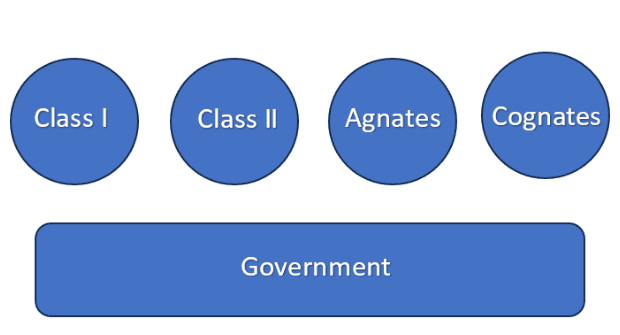
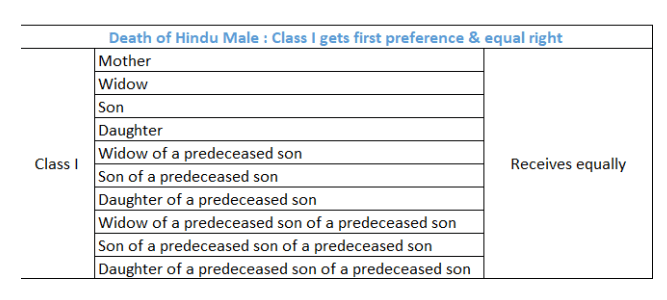
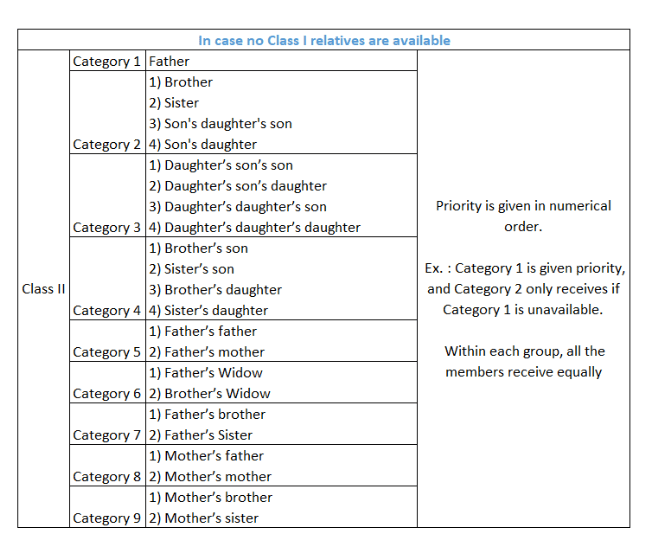
Agnates and Cognates
Agnates and cognates are not enumerated heirs. They inherit only in the absence of Class I and Class II heirs.
Agnates
An agnate is a person who traces his relationship to the intestate wholly through males. The sex of the agnate is immaterial. Agnates are classified into:
Descendant agnates
Ascendant agnates
Collateral agnates
There is no limit to the degrees of relationship among agnates.
Cognates
Cognates are relatives who trace their relationship to the intestate through one or more females.
Like agnates, cognates may be descendants, ascendants, or collaterals.
Among collateral cognates, uterine brother and sister are the nearest collateral cognates.
Rules of Preference between Agnates and Cognates
Agnates are always preferred over cognates. The distribution of property among agnates and cognates is governed by Section 12 of the Act, which lays down the following rules:
Of two heirs, the one with fewer or no degrees of ascent is preferred.
Where degrees of ascent are equal or none, the one with fewer or no degrees of descent is preferred.
Where neither heir is entitled to preference, they take simultaneously.
For ease of application, these rules are further simplified based on whether the claimants are descendants, ascendants, or collaterals.
Notional Partition and Coparcenary Property
The concept of notional or deemed partition is applied for the limited purpose of demarcating the share of a deceased coparcener. It is not a real partition and does not result in severance of status. On the death of a coparcener leaving behind a Class I female heir or a male heir claiming through such female, his interest in the coparcenary property devolves by succession and not by survivorship. The share of the deceased coparcener is determined as if a partition had taken place immediately before his death.
Property that comes by virtue of partition becomes separate property and devolves by succession.
The Hindu Succession Act, 1956 establishes a clear hierarchy of heirs and a structured scheme of inheritance. The inclusion of daughters as coparceners and the expansion of Class I heirs through legislative amendments reflect a progressive approach toward gender equality. At the same time, the Act preserves traditional principles such as agnatic preference and representation, ensuring continuity with classical Hindu law while adapting to contemporary realities.